
Condition Monitoring
Condition monitoring tracks how equipment is running in real time, including vibration, temperature, pressure, flow, runtime, and fault states, so early signs of wear or failure are caught before they turn into downtime or costly repairs.
Exosite gives equipment makers and service teams the complete system to offer it: connectivity for sensors, PLCs, and gateways, a real-time data pipeline with rules and alerts, and dashboards your customers use as your own application.
Real-time machine data, wherever your team is. Live and historical equipment data helps predict and prevent issues before they cause downtime or costly repairs.
- Preventative Maintenance
- Greater Efficiencies
- Data-Driven Decision Making and Analysis

Key Aspects of Condition Monitoring
Condition monitoring is a critical part of any predictive maintenance strategy. It brings together technologies that collect, store, process, visualize, and deliver data to improve equipment reliability and performance.
Sensors, PLCs, and integrations
Some machines already report through PLCs; others need added sensors. Industrial IoT brings every source into one system.
Data collection
A time-series database built for high-volume sensor and status data tracks performance over time.
Real-time data pipeline
Rules and logic run on the data stream to detect anomalies, track state changes, and trigger alerts.
Visualization and analytics
Live and historical views help teams spot patterns, plan maintenance, and extend asset life.
Condition monitoring in practice. Common ways equipment makers and service teams use condition data on Exosite today.
Rotating equipment
Motors and bearings
Bearings are one of the most common failure points on motors, fans, and conveyors. Ultrasonic and vibration sensing picks up early wear well before it can be heard or felt.
What's monitored
Ultrasonic levels, vibration, and bearing temperature.
How the data is used
- Trend bearing health over weeks and months, not just the current reading
- Notify maintenance when lubrication is needed, based on measured condition instead of a fixed schedule
- Export history for reliability reporting and maintenance planning
For background on the sensing methods behind these examples, read Common Condition Monitoring Sensors & Techniques →
Connect the equipment already in the field. Most machines you'll monitor were installed years ago. Many already collect the data you need in a PLC or controller, with no way to get it out.
Exosite connects to that installed base without replacing it. Gateways read existing PLC tags over industrial protocols, and retrofit sensors fill in signals the machine never measured. Legacy and new equipment land in the same asset models, dashboards, and rules.
How machine builders connect PLC data with an HMS Ewon Flexy →
PLCs and controllers
Data machines already collect in PLCs from Rockwell/Allen-Bradley, Siemens, Schneider Electric, Mitsubishi Electric, Omron, and others.
Industrial gateways
Read PLC tags over Modbus, BACnet/IP, and OPC UA, then publish them securely to Exosite.
Retrofit sensors
Wired and wireless sensors add vibration, temperature, current, and other signals to equipment that never measured them.
Scale, Robustness, Security
Exosite's platform connects millions of IoT endpoints, sensors, devices, and machines. Murano handles device connectivity, provisioning, and data storage, and ExoSense applies the same asset templates, rules, and dashboards whether you've deployed ten machines or ten thousand, across customers and regions.
Pump Station 3
Minneapolis, MN
Built to scale
Consistent performance from a single line to a global network of sites, without managing infrastructure.
Engineered for robustness
Handles noisy, intermittent, and high-volume equipment data, with message queueing through connectivity outages so readings aren't lost.
Security and permissions
Encryption, secure device provisioning, and role-based access control who sees what.
Multi-tenant by design
Each customer sees only their own sites and assets. Your service team sees the whole installed base.
Code-less configuration
Asset templates, rules, dashboards, and workflows are configured, not coded, so new equipment types roll out quickly.
Deployment options
Run on Exosite's cloud, a dedicated cloud, or on premises.
Offer it to your customers
Condition monitoring becomes a service you sell with your equipment, not a tool your customers have to build. You set up the asset types, signals, rules, and onboarding flow around the equipment you make, and each customer logs in to see their own machines.
Building it yourself on AWS IoT or Azure IoT Hub means assembling services, staffing a software team, and maintaining it for as long as the product ships.
ExoSense
The condition monitoring application: assets, data pipelines, rules, dashboards, and access controls, configured without code.
Murano Industrial IoT platform
Connectivity, data storage, and custom integrations underneath ExoSense, available as cloud, dedicated cloud, or on premises. Learn more →
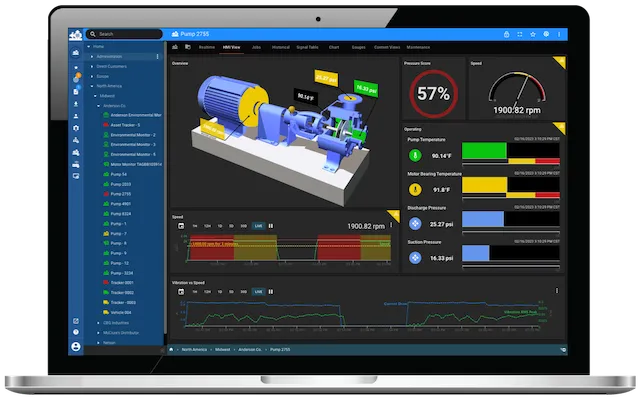
Ultrasonics Enable Predictive Maintenance for Bearings
UE Insights and OnTrak Wireless system extend the life of bearings by remotely monitoring and lubricating them from anywhere, anytime.
Key Takeaways
- Customers gain real-time and historical insight into bearing health.
- Receive notifications when lubrication is needed, based on condition monitoring.
- Easily access data for reporting and analysis to support proactive maintenance planning.
Frequently Asked Questions
What is condition monitoring?
Continuously measuring signals that reflect equipment health, such as vibration, temperature, pressure, current, and runtime, and acting when they move out of their normal range. The goal is to catch wear and faults early, before they cause downtime.
How is condition monitoring different from predictive maintenance?
Condition monitoring shows how equipment is running now and alerts on thresholds and state changes. Predictive maintenance builds on that history with models that forecast failures and remaining life. Most teams start with condition monitoring. More on predictive maintenance →
Which sensors do we need?
It depends on the equipment and the failures you want to catch: vibration for rotating equipment, ultrasonic for bearings and air leaks, current for motors, temperature almost everywhere. Common sensors and techniques →
Can we monitor equipment that's already installed?
Yes. Gateways read data from existing PLCs and controllers over industrial protocols, and retrofit sensors add signals where none exist. Legacy and new equipment use the same asset models, dashboards, and rules.
Can we offer condition monitoring to our customers as our own service?
Yes. ExoSense is white-labeled and multi-tenant: each customer sees only their own equipment, while your team manages the full installed base.
Can we monitor equipment across many sites and customers?
Yes. ExoSense organizes assets in a group hierarchy, for example by customer, site, and line. Each user sees only the groups they have access to, and dashboards and alerts work at any level, so one team can watch the whole installed base.
Does it come with dashboards and anomaly detection, or do we build them?
Asset templates include dashboards, rules, and alerts, so each new machine is set up from a template instead of from scratch. Rules for thresholds, timeouts, repeating values, and trend baselines are built in, and anomaly detection and other machine learning models can be added as Insight functions.
How do alerts reach the right people?
Rules send email and SMS notifications through notification lists, so each alert goes to the people responsible for that equipment. Alert emails can come from your own domain.
What hardware works for outdoor or remote equipment?
Exosite is hardware-agnostic. Remote equipment usually connects through industrial cellular or LoRaWAN gateways, with sensors rated for the site's temperature, moisture, and hazardous-area requirements. Choosing sensors for harsh environments →
Do we need developers to set it up?
No. Assets, rules, dashboards, and access are configured in ExoSense without code. Custom algorithms can be added as Insight functions when you need them.
Related solutions
The same platform and the same connected equipment support each of these.