
June 17, 2026
Product Updates: Hysteresis for Threshold Rules
By Mike Aanenson · 3 min read · Product
Spend enough time around a condition monitoring deployment and you’ll eventually hear someone ask why an alarm keeps clearing itself. Not because the equipment recovered - because a vibration or temperature reading is sitting right on the alarm line, drifting up and down by a fraction of a unit every scan. Each drift trips the rule, then clears it, then trips it again. Every trip and clear gets logged, every one notifies whoever’s on the list, and if that list is wired to SMS, every one is a text message. Multiply that by a few dozen assets and it stops looking like alerting and starts looking like noise.
What Hysteresis Does
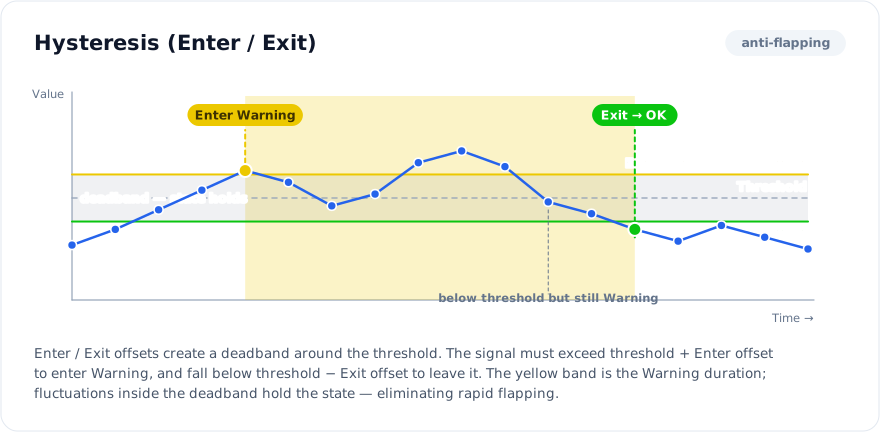
Threshold Rules now support hysteresis: a dead-band around the threshold so the condition that clears an alarm isn’t the same line as the condition that triggers it. Once a rule activates, the signal has to move a defined amount past the threshold before the active state clears, not just drift back across it.
There are two parameters. Hysteresis Enter shifts the entry threshold in the triggering direction. Hysteresis Exit shifts the exit threshold in the clearing direction. With a threshold of > 75 and a Hysteresis Exit of 1.2, a signal has to drop below 73.8 to return to Normal - not just below 75.
Flapping vs. Hysteresis
The difference shows up clearest side by side. The same noisy signal, run through two rules: one plain threshold, one with hysteresis added.
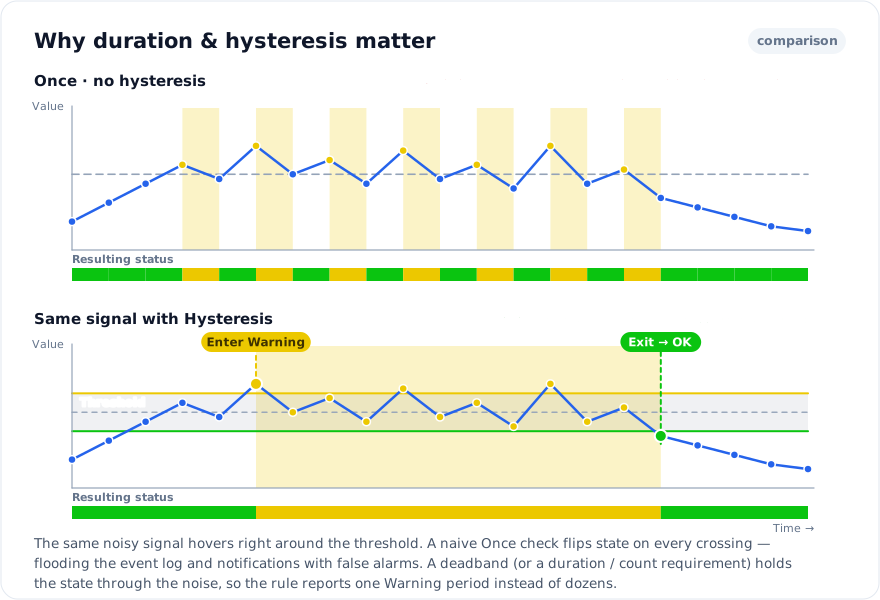
Without hysteresis, the alarm state trips and clears repeatedly as the signal wanders near the line - a wall of trip/clear pairs in the event log for what is, functionally, one ongoing condition. With hysteresis, the signal has to genuinely recover before the rule clears, so that same stretch of noisy data produces one clean alarm event instead of ten.
Combining Hysteresis with Duration
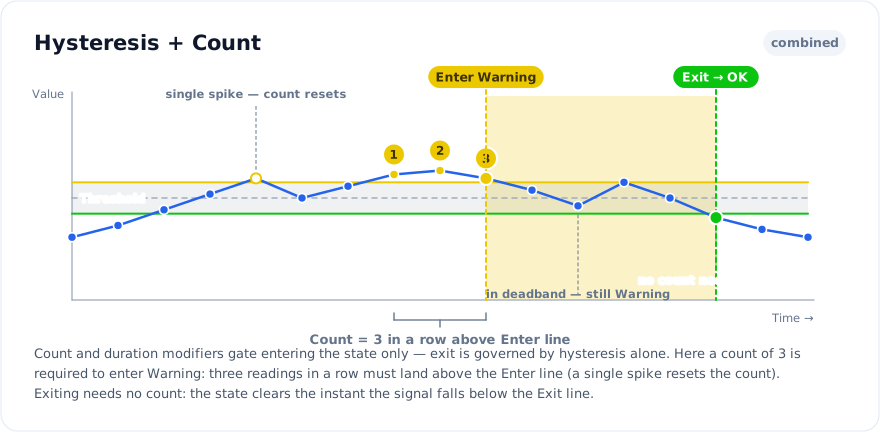
Hysteresis can be paired with the existing Duration options for even more stability - requiring a signal to hold past the hysteresis exit point for a minimum number of readings, not just a single scan, before the rule actually clears.
Why This Matters for Condition Monitoring
The real risk in condition monitoring usually isn’t missing an alarm. It’s a team that’s learned to tune out alarms because too many of them are noise. A vibration alarm on a pump bearing that flaps a dozen times a shift trains the on-call tech to glance at their phone and move on - and the one time it’s a genuine problem, it looks exactly like the ninety-nine times it wasn’t. Hysteresis is a small setting with an outsized effect on whether an alarm still means something six months into a deployment.
Also in This Release
This release also added a Milli Standard Gravity (mg) unit to the signal library, matching how vibration accelerometers on motors, pumps, and fans typically report data, and early access to Template Asset Parameter Overrides, which extends the per-asset override model from the March 2025 update down to individual parameter values within a template.
Full release notes: current release notes, v3.29.0. Hysteresis documentation: Rules - Exosite Documentation.
Chasing down false vibration alarms? Schedule a Demo.